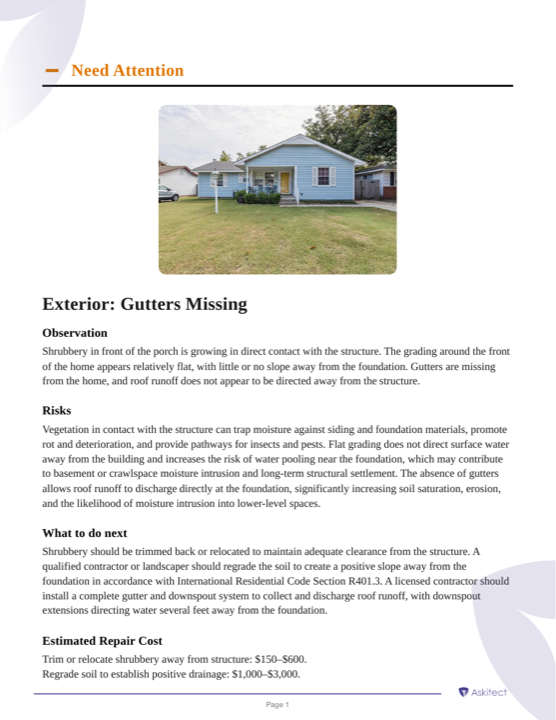
An AI home inspection is a property condition review built from photos instead of an on-site visit. You photograph what you want inspected; Askitect checks it against 685 conditions across 51 areas of the house and returns a professional condition report within one hour, with each finding rated Fine, Need Attention, or Need Action Now.
An AI home inspection reviews photos you upload; a traditional inspection sends a licensed inspector to walk the property. Askitect checks every major system visible in your photos against 685 conditions across 51 areas of the house, then returns a PDF report. Photo-based review does not test, measure, or open anything.
AI home inspection compared with a traditional home inspection
Aspect
Traditional inspection
Askitect AI inspection
How it starts
Book an inspector and wait for an appointment.
Take photos of the areas you want inspected and upload them in the app or on the web.
Who is on site
A licensed inspector walks the property.
You, or whoever can take the photos: an agent, a tenant, a property manager.
Turnaround
An on-site visit, then a written report delivered afterwards.
A professional property condition report within one hour of upload.
What gets evaluated
Visible, accessible systems, checked in person.
Every major system visible in your photos, against 685 checks across 51 areas of the house.
What it cannot see
Inside walls, under fixed finishes, anything not accessible on the day.
Anything not in the photos. Photo-based review does not test, measure, or open anything.
The report
Format varies by inspector.
A PDF with a condition overview, defects grouped by area, and one page per finding with observation, risks, next steps, and an estimated repair cost range.
An Askitect AI home inspection report is a PDF that opens with a condition overview rating every finding Fine, Need Attention, or Need Action Now, lists the defects grouped by area, then gives each finding its own page with the observation, the risks, what to do next, and an estimated repair cost range.
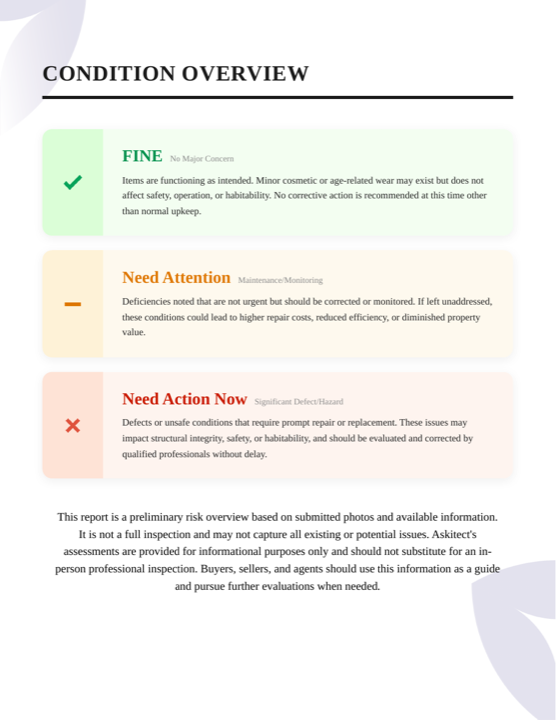
Pages from the published sample report.
Condition overview
The report opens with a three-level scale. Every finding in the document carries one of these ratings.
Fine No major concern
Items are functioning as intended. Minor cosmetic or age-related wear may exist but does not affect safety, operation, or habitability.
Need Attention Maintenance / monitoring
Deficiencies that are not urgent but should be corrected or monitored. Left alone, they can lead to higher repair costs, reduced efficiency, or diminished property value.
Need Action Now Significant defect / hazard
Defects or unsafe conditions that require prompt repair or replacement. They may affect structural integrity, safety, or habitability and should be evaluated by qualified professionals without delay.
Code sections, costs, and review
Each finding page cites the relevant code section, for example International Residential Code Section R401.3 for site drainage or National Electrical Code Section 210.8(A) for GFCI protection, and gives a repair cost range per corrective item. The published sample report covers 22 findings on a single-family house and was reviewed for accuracy by a licensed architect before delivery.